 Span
You didn't become a trainer to do admin.
Serious programming, set-by-set logging and recovery tracking, in an app your clients actually use. The trainer console is what this beta is for.
The week you actually have
Coaching is the job. The rest of it isn't.
Most of what eats a trainer's week has nothing to do with training anyone.
The same programme, rebuilt
You have a method. You rewrite it from scratch for every client, in a new file, every block.
Five days you can't see
You get two hours a week with them. What happens in the other hundred and sixty-six is a guess.
Progress you can't look up
What they lifted in March is in a notes app, a spreadsheet, or your memory. None of those are searchable.
What Span is
An app your clients train with. A console you run.
Span is two halves. The client half is built and in daily use. It is what the rest of this page shows you. The trainer half is what the beta exists to shape, with the people who will use it.
What that buys you today: a client who logs every set, every sauna, every session, so when they walk in you are looking at what actually happened rather than what they remember. Turning that into a roster you can scan at a glance is the console's job, and founding trainers decide what it shows.
The client app
Programming, the session itself, and recovery. On their phone, every day, whether or not you are in the room.
The trainer console
A web console for your roster, invites and adherence. Founding trainers get it first and decide what it does.
Programming
Programming that respects your method.
Span speaks the language you already work in. Mesocycles, accumulation, deloads, supersets, reps in reserve. Not "workouts" and "challenges".
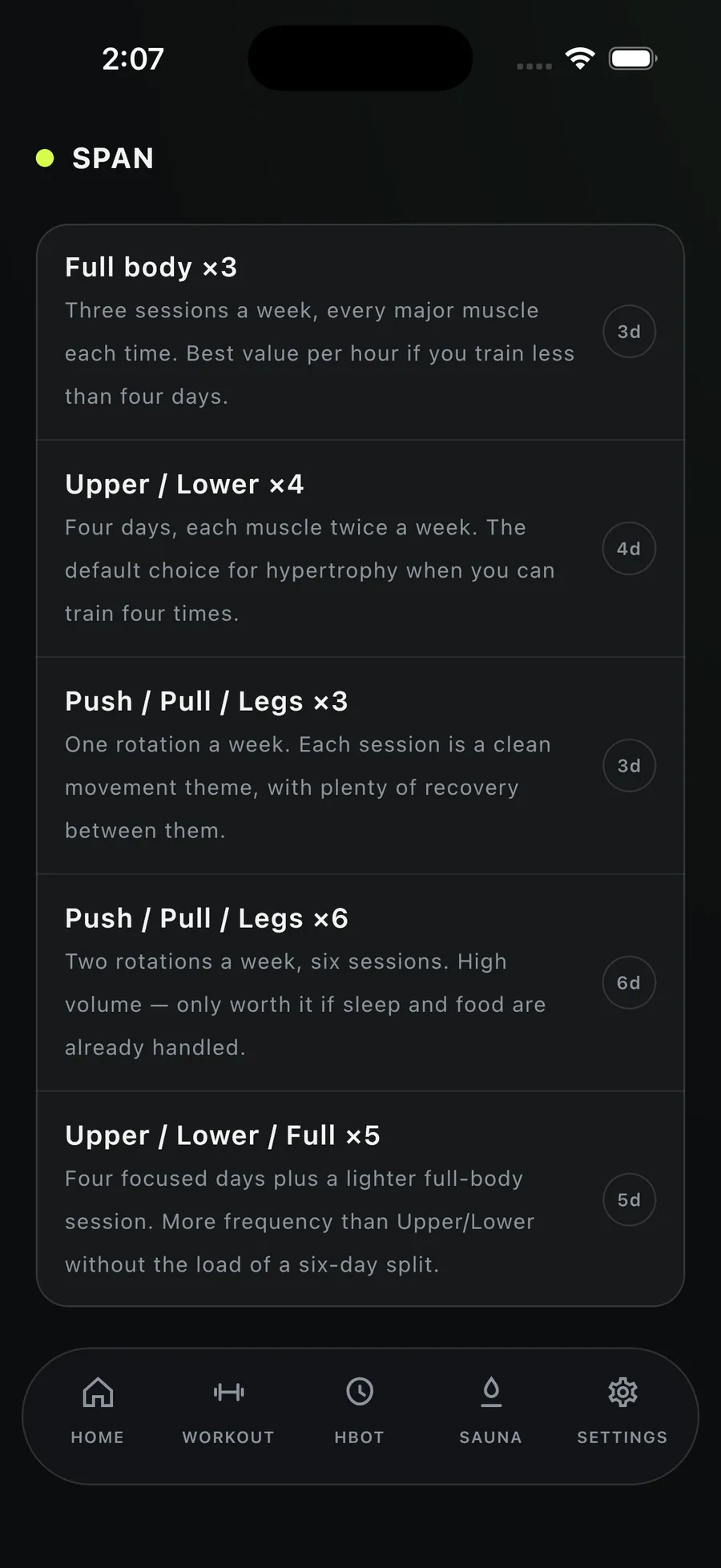
Five archetypes, each with the reasoning for when to pick it, not just a name.
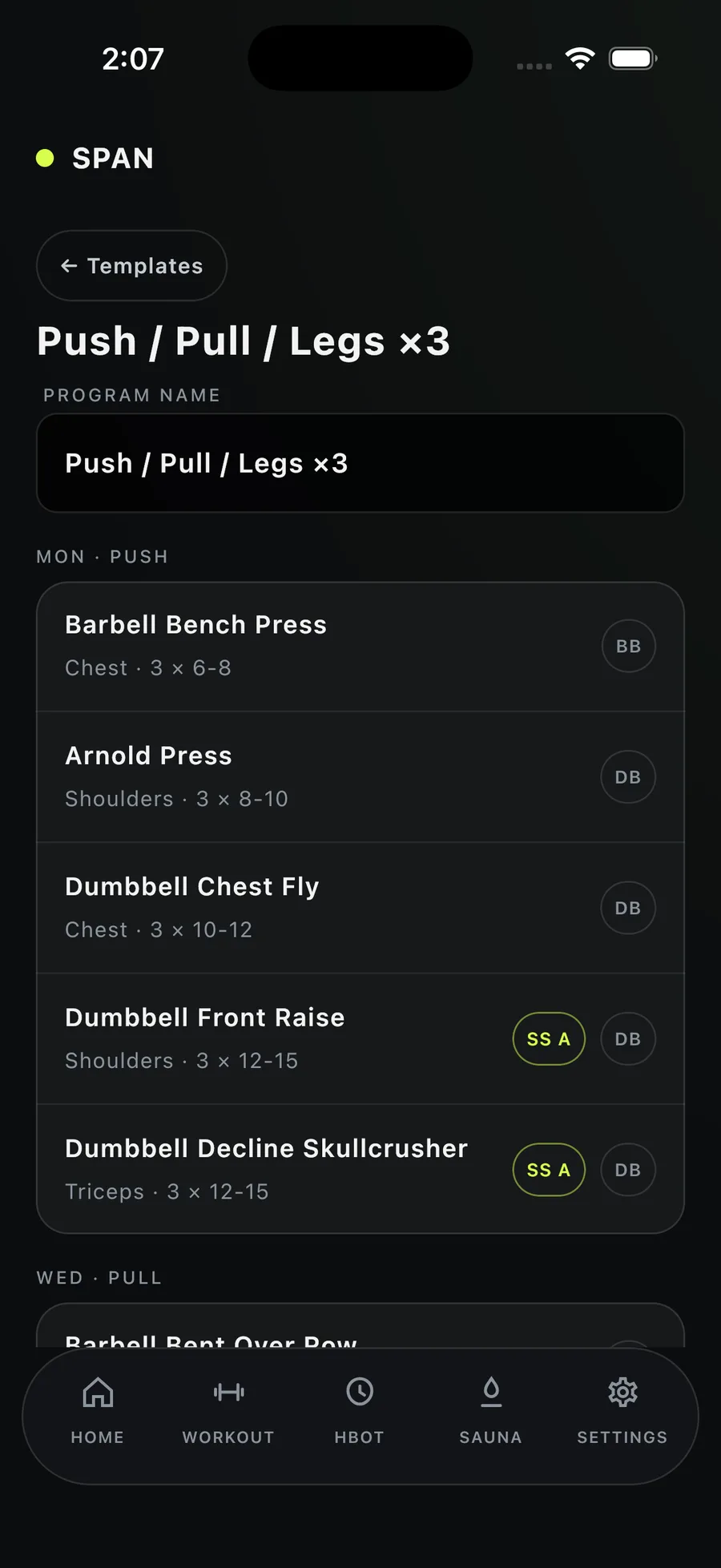
Or build it yourself: day by day, superset pairs, equipment, sets and reps.
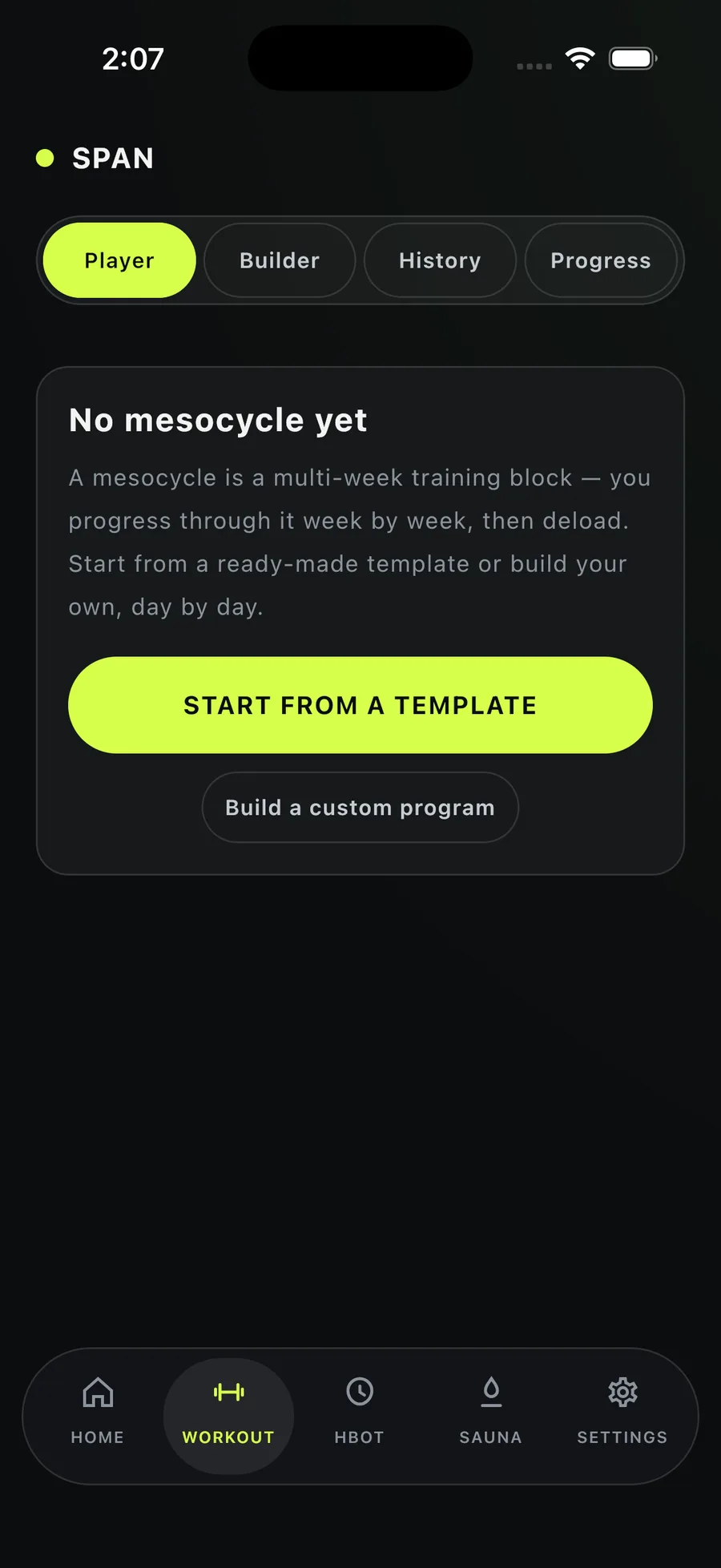
And it explains itself to the client, so periodisation isn't a thing you have to teach twice.
On the gym floor
What your client does when you're not there.
The part that decides whether any of this works: whether they open it mid-set, in a busy gym, with cold hands.
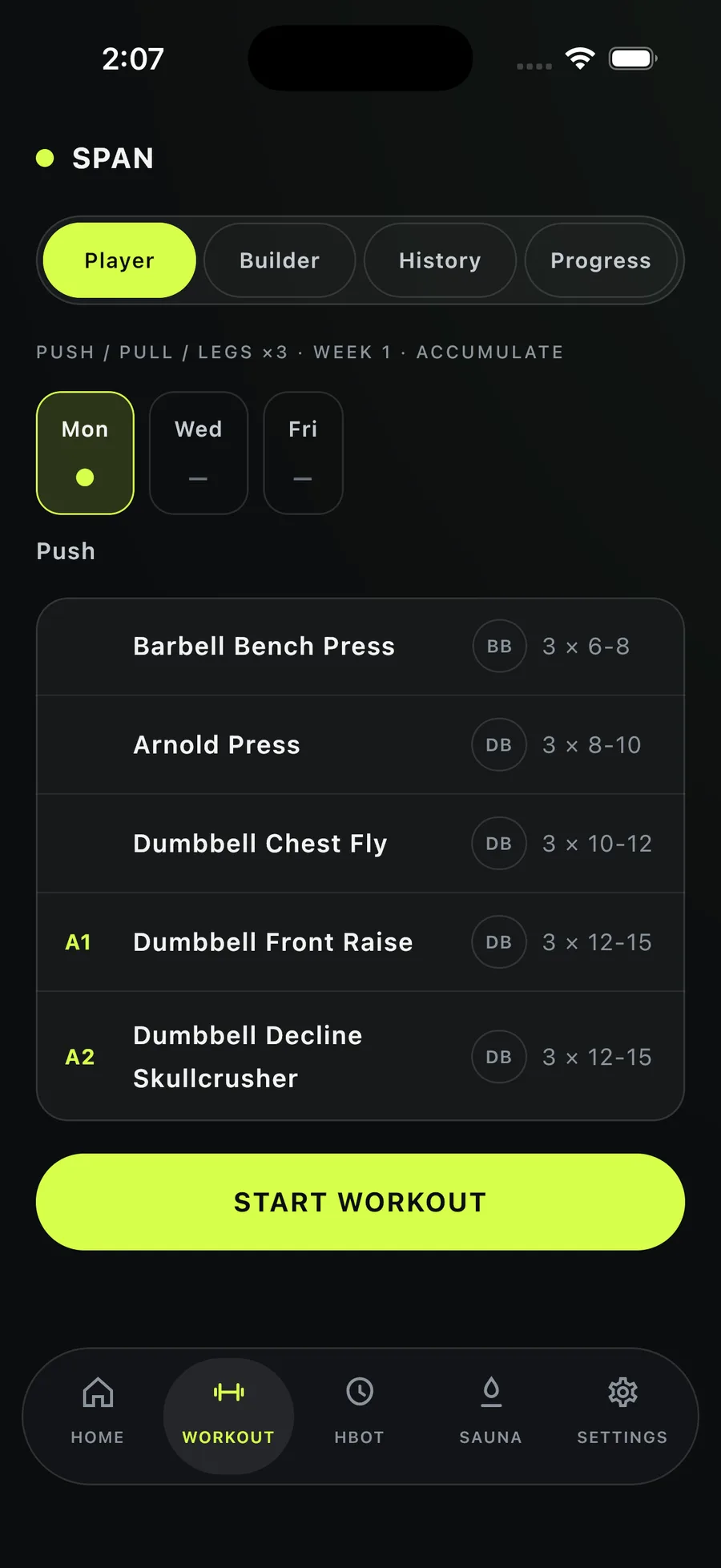
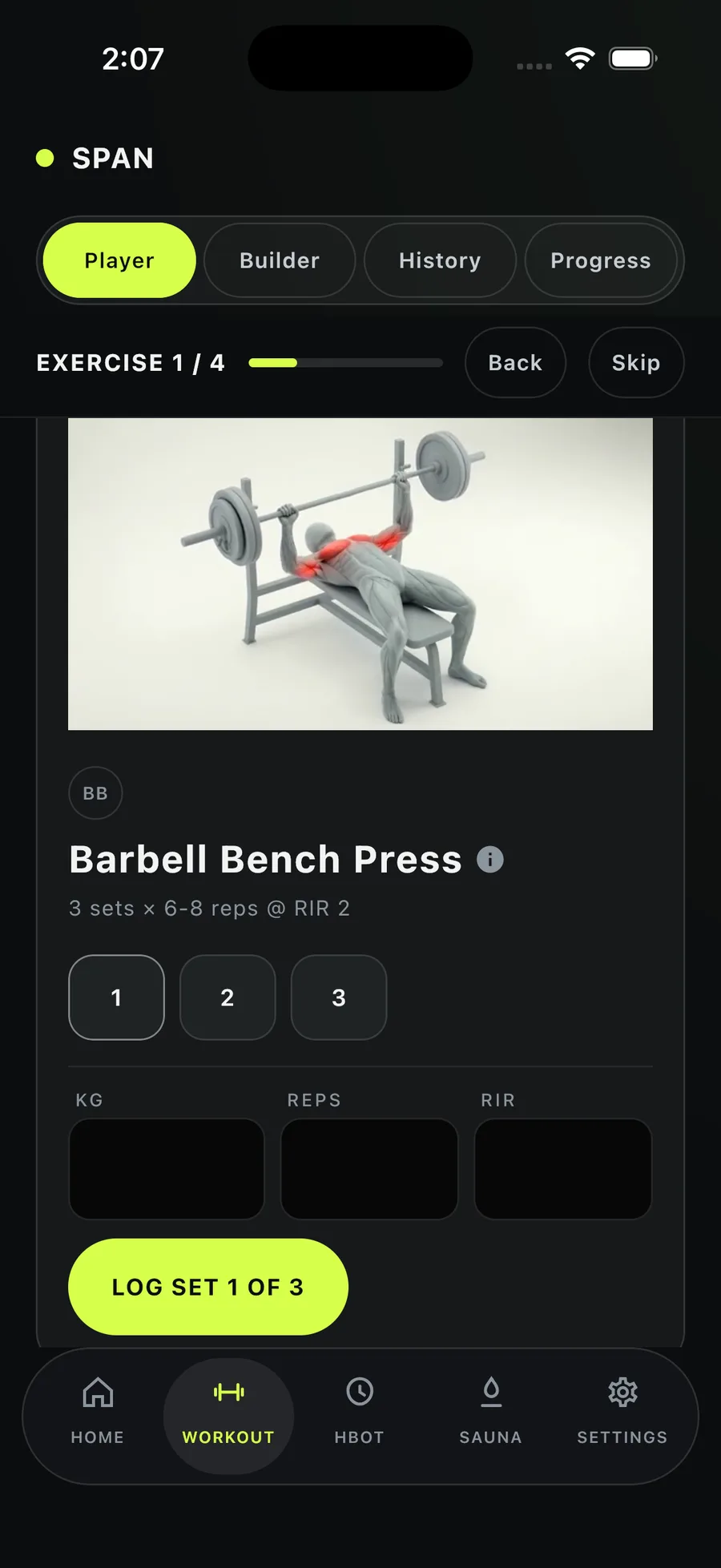
The day's session, where they are in the block, and one button to start.
Set by set: kilos, reps, reps in reserve, and a render showing what should be working.
Recovery
Recovery counts as training.
Sauna and hyperbaric sessions are logged as first-class work, not notes. Each modality carries its own colour, so a client knows which surface they're on before they read a word.
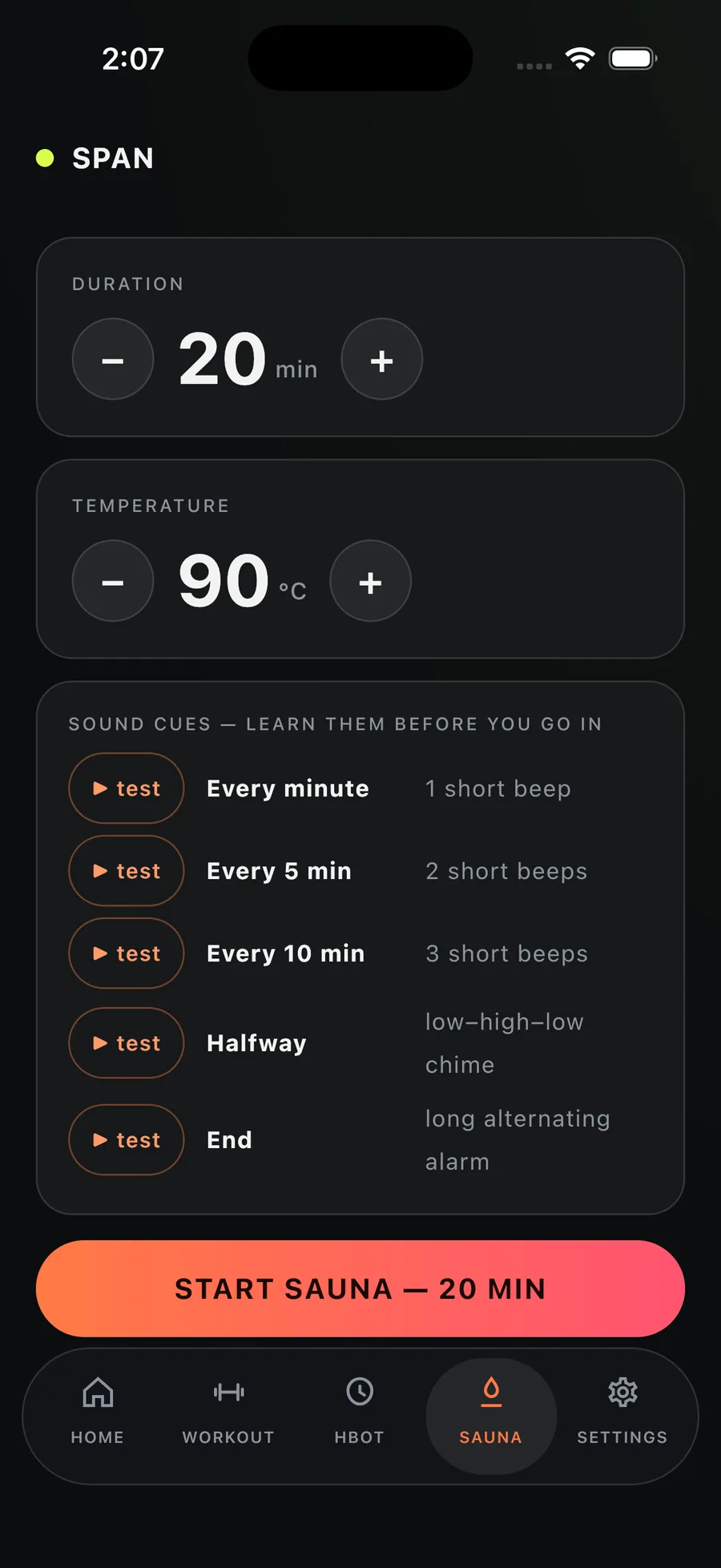
Audio cues you learn before you go in, because nobody is reading a screen at 90°C.
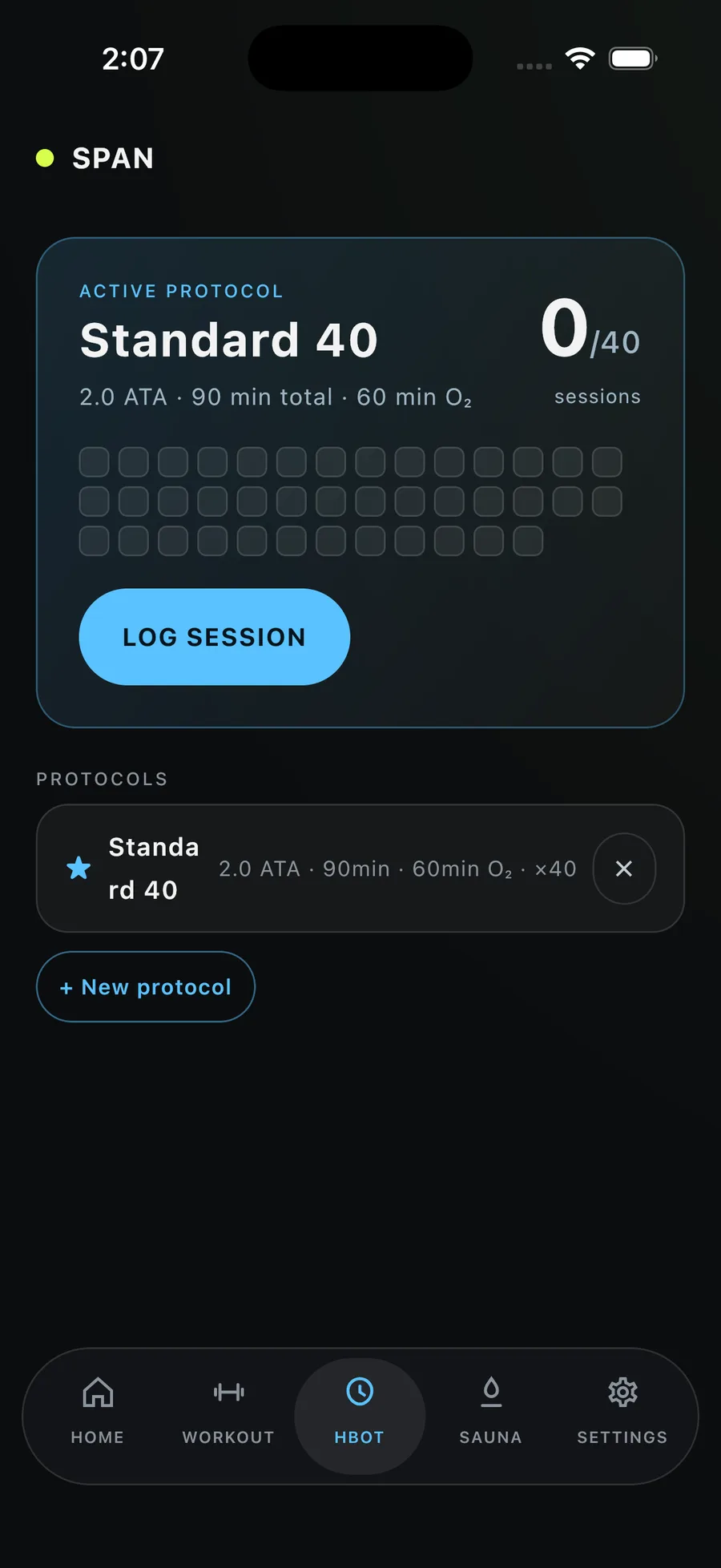
Hyperbaric protocols tracked as a course (0 of 40), because that's how the dose actually works.
The long game
Built for clients who aren't chasing a twelve-week photo.
Span is shaped for the clients who make up most of a serious trainer's book: people in their forties, fifties and beyond, training for strength, function and independence they'll still have in twenty years. That changes the unit of time. Courses counted in forties, blocks in months, progress read in seasons, not a countdown to a deadline that ends the relationship.
Your side of it
The trainer console.
Your roster, your invites, who trained this week and who quietly stopped. It runs in a browser, not the app. It isn't built yet, and that is exactly what we want founding trainers for. The client app is finished enough to be useful today; the console gets designed around the people who join now.
Console screens go here once there are real ones to show.
Who builds it
Made by RBB LAB.
Span is built by the studio, not a side project. RBB LAB is a software team in San Marino that ships production systems for companies who need them to hold up. The same people are behind this, which is why the training log is a real training log.
Questions
The things trainers ask first.
What do my clients need to install?
The Span app, on their phone or tablet. During the beta they set up their programme in the app themselves, from a template or built from scratch, and you shape it with them. Assigning programmes from your side is what the trainer console will do.
Will my clients see my branding?
Co-branding is part of what we're building with founding trainers. It is not in the app today, and we would rather tell you that than let you find out after you have invited twenty people.
Does Span replace the software my gym already uses?
No. Span covers programming, sessions and recovery for your clients. Billing, door access and room booking stay wherever they are now.
What happens to a client's history if they stop training with me?
It stays theirs. Their training history belongs to them, not to your roster, and it follows them.
Does it handle recovery as well as training?
Sauna and hyperbaric sessions are tracked as first-class work today, including protocol courses counted across dozens of sessions rather than logged one at a time. More modalities are coming.
What does joining the beta actually involve?
You put a few clients on it, you tell us what breaks, and you get a direct say in what the trainer console becomes. We are keeping the group small enough to answer every message.
What will it cost?
Nothing has been priced yet. Founding trainers will hear about pricing from us before it applies to them, not from a billing screen.
Founding trainers
Join the private beta.
Small group, real input, direct line to the people building it. Tell us a little about how you work and we'll be in touch.